Why the Flare Hem Pulls Your Waistband Down and How to Stop It
Quick Answer: A flare hem is heavier and catches more air and friction than a straight one, and all of that load transfers up the leg to the waistband. The result is a slow downward drag that a straight-leg pair never produces. Four fixes, in order of effectiveness: get the length right so the hem is not dragging, choose a wider waistband with a proper elastic core, size down at the waist rather than at the leg, and check the rise - a mid-rise flare slides far more than a high-rise one because there is less surface holding it.
It is one of the most common complaints about flares and it gets misdiagnosed as a sizing problem almost every time. The waistband is usually fine. It is being pulled.

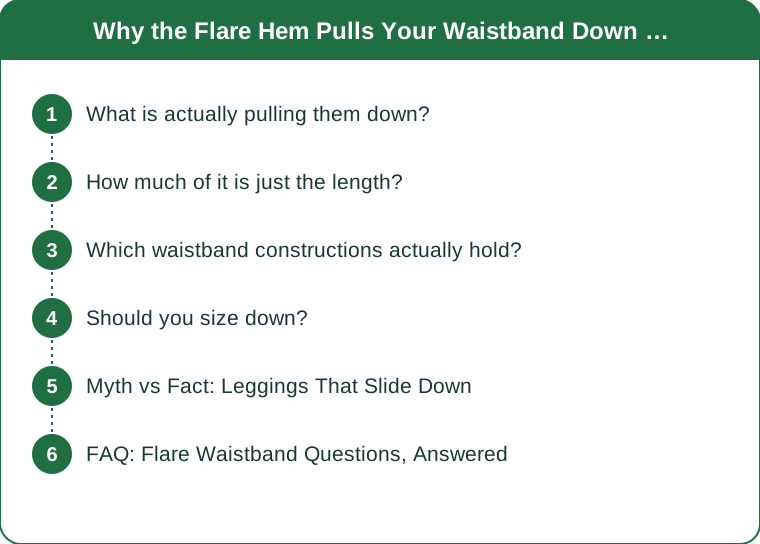
What is actually pulling them down?
Three loads that a straight-leg legging does not have, all acting downward.
Fabric weight at the hem. A flare hem circumference is typically 50-80% larger than a straight one. That is a meaningful amount of extra fabric hanging at the furthest point from the waistband, and it is all working with gravity.
Friction against the floor and your shoes. If the hem touches the ground at any point in your stride - and on most flares it does - each step delivers a small downward tug. Over eight hours and roughly 7,000 steps, those tugs accumulate into a genuinely noticeable drop.
Air resistance and swing. A flare hem moves. Walking briskly, going down stairs, or getting in and out of a car all swing the hem, and every swing pulls slightly on the leg above it.
Why it feels like a waistband problem: all three loads travel up the leg and are ultimately resisted by the waistband, which is the only thing anchoring the garment. The waistband is the place where the failure becomes visible, not the place where it originates.
How much of it is just the length?
Most of it, honestly. Length is the single biggest variable and the easiest to fix.
The target: the hem should sit roughly 1cm off the ground in the shoes you actually wear. Not barefoot, not in trainers if you wear flats.
A hem that touches the floor is being stepped on dozens of times an hour. Each contact is a direct downward pull applied at the furthest possible point from the anchor.
The test: put them on with your usual shoes and walk ten steps on a hard floor. Watch the hem at the back of the heel. If it contacts the ground at any point in the stride, that is your problem, and no waistband will fully solve it.
The complication: flare leggings are designed to be worn with a small heel, and most people wear them with flats. A 3cm heel and a flat shoe change the effective length by 3cm, which is exactly the difference between a hem that clears and one that drags.
The fix is hemming, and on a flare it needs doing properly - a straight cut removes the flare’s angle. A tailor takes it up from the hem while preserving the taper for a small fee, and it transforms the garment.
Which waistband constructions actually hold?
There is a clear hierarchy here, and it is visible from the product photos if you know what to look for.
Best: a wide waistband with a separate elastic band inside. Usually 10cm or more, with a distinct band of elastic sewn into a casing. This gives you both surface area and genuine grip, and it is the only construction that reliably resists a heavy flare.
Good: a wide, doubled fabric waistband with a drawstring. The drawstring is doing real work here rather than being decorative. If a flare has a functional drawstring, use it - this is not a garment where it is optional.
Adequate: a wide fold-over band with no elastic core. Relies entirely on compression and it loosens as the fabric warms and relaxes through the day.
Worst: a narrow band, and anything under about 6cm. There is not enough surface holding against a heavy hem, and this is where roll-down happens.
One feature worth looking for: a silicone strip or a brushed inner surface at the top edge of the waistband. It adds genuine grip against skin or against a base layer, and it is common in running tights and rare in flares - when a brand includes it, it is usually a sign they have thought about this exact problem.

Should you size down?
At the waist, sometimes. Everywhere, no - and this is where people go wrong.
The instinct is to buy a whole size smaller so the waistband grips harder. That gives you a tighter waist and also a tighter thigh and calf, which increases the friction and drag along the whole leg. Some people find it makes the sliding worse rather than better.
The better approach if the waist is the issue specifically:
Check the rise first. A mid-rise flare sits at the narrowest part of your torso with very little above it, so there is nothing to stop it travelling downward. A high-rise sits above the waist, on a widening part of the body, and physically cannot slide as far. Switching from mid to high rise fixes this for a lot of people without changing size at all.
Then look at the construction, per the section above.
Then consider sizing down - and only if the leg fit in the smaller size is still comfortable. If sizing down makes the hem area snug, you have traded one problem for a worse one, because a snug flare hem is not a flare any more.
Myth vs Fact: Leggings That Slide Down
Myth: It means you bought the wrong size. Fact: Usually it means you bought the wrong length or the wrong rise. The waist measurement is often correct - it is just being asked to hold more load than a straight-leg pair.
Myth: A tighter waistband is always the answer. Fact: Beyond a point, a tighter band digs in and rolls rather than gripping. Width and elastic core beat tightness, and a wide band at moderate tension holds far better than a narrow band cranked tight.
Myth: Heavier fabric holds up better. Fact: Heavier fabric means a heavier hem, which is the source of the load. A moderate-weight flare with a good waistband outperforms a heavy one with a mediocre band.
Myth: They will stop sliding once they are broken in. Fact: It goes the other way. Waistband elastic loses tension over time, particularly with hot washing, so a pair that slides slightly at week one slides more at month six.
Myth: Wearing a longer top hides the problem. Fact: It hides the symptom and adds friction at the waistband, which sometimes makes the sliding slightly worse.
FAQ: Flare Waistband Questions, Answered
Can I fix a pair I already own?
Yes, in order of cost: use the drawstring if there is one, hem them to the right length for your usual shoes, or have a tailor insert elastic into the waistband casing - a genuinely common and inexpensive alteration.
Does washing affect this?
Significantly. Hot water and tumble drying degrade waistband elastic faster than anything else, and a flare puts more demand on that elastic than a straight leg does. Cold wash, hang dry, and no fabric softener.
Why does it happen more on some days?
Humidity and heat. Warm damp fabric is more slippery against skin and the elastic is softer. A pair that holds fine in October may slide in a warm late-August week - which is worth knowing before you replace them.
Do I need a different pair for flats and heels?
Or one pair hemmed for flats, since that is what most people wear most of the time. Buying for the heels you wear occasionally is why so many flares drag.
TL;DR:
- The hem is pulling, not the waistband failing - extra fabric weight, floor friction, and swing all load downward.
- Length is the biggest fix: the hem should clear the floor by about 1cm in the shoes you actually wear.
- Look for a wide waistband with a separate elastic core, and use the drawstring if there is one.
- Switch rise before you switch size - high-rise slides far less than mid-rise.
- Cold wash, hang dry. Waistband elastic is the component doing the work and heat is what kills it.
Flares are worth the small amount of fuss because nothing else reads as smart while being a legging. Get the length right and most of the fuss disappears.
See It in Motion
Seen here: Bootcut Capri Yoga Pants with Pockets — shop similar styles on bubblelime.com
Keep Reading
This article is for general informational and styling purposes only. Fit, sizing, and product availability may vary.