Why Flare Leggings Look Different Under Artificial Light
Quick Answer: Fabric colour and sheen are both light-dependent, not fixed properties. Shop lighting is typically bright, high-colour-temperature and directional, which flattens texture, deepens blacks and exaggerates sheen. Home lighting is usually warm, dimmer and diffuse, which reveals undertone, shows fabric texture, and makes dark colours read as brown or grey. Neither is a lie. To judge a pair properly, look at them in daylight near a window, which is the closest thing to a neutral reference and the light most people will actually see you in.
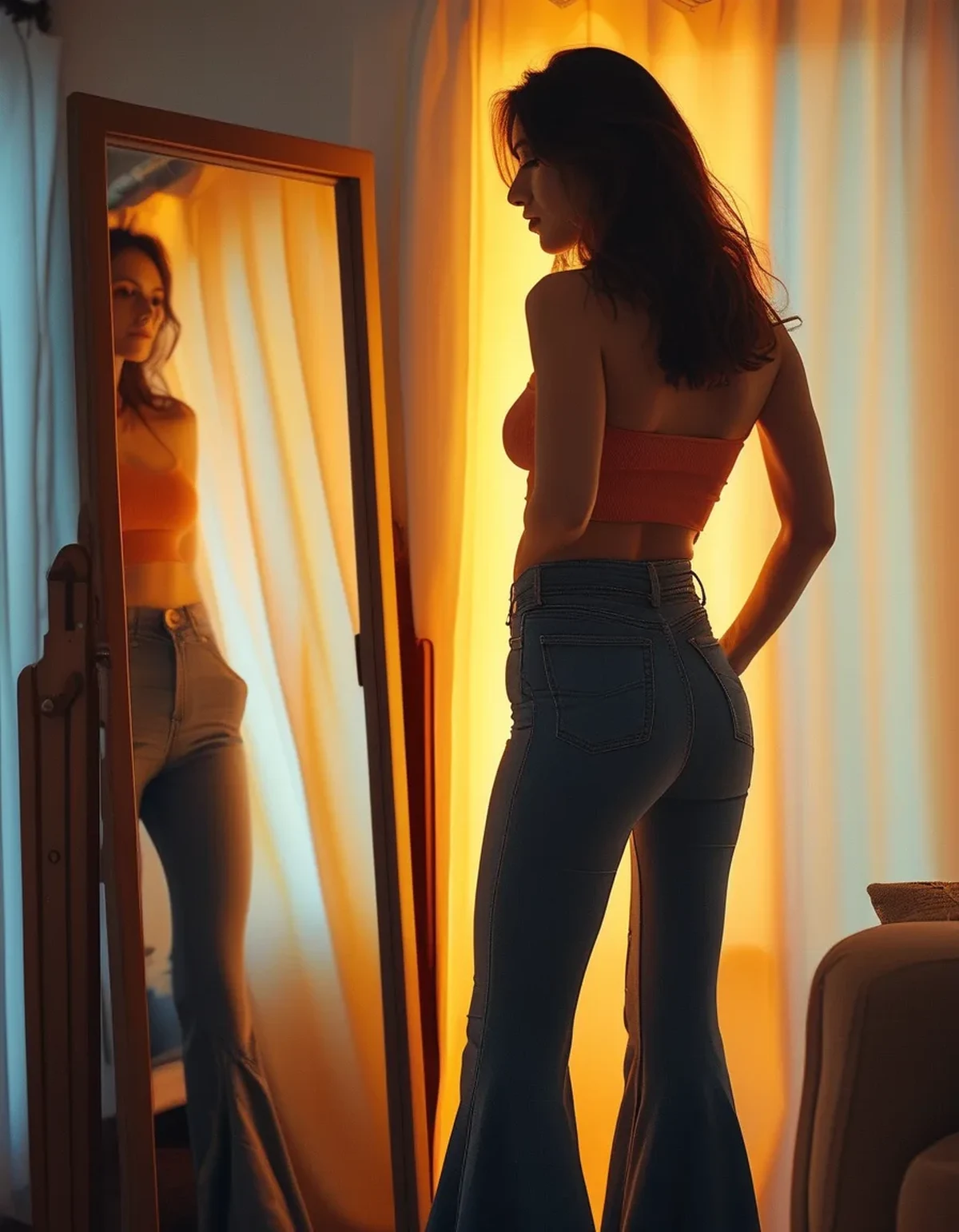
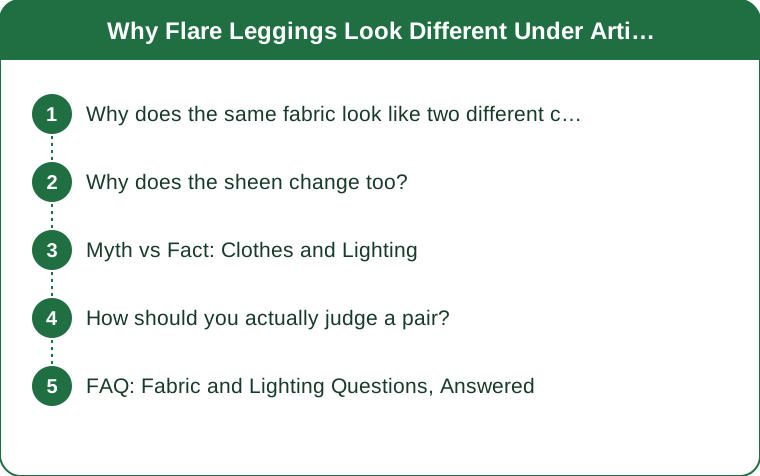
The flare leggings looked deep black and slightly lustrous in the shop. At home under a lamp they are a dusty charcoal with a visible weave.
Nothing was misrepresented, and the pair has not changed. You are looking at them under a light source with completely different properties, and fabric colour is a relationship between the fabric and the light, not a fixed number.
Once you know which light does what, you can predict how a pair will read before you buy it.
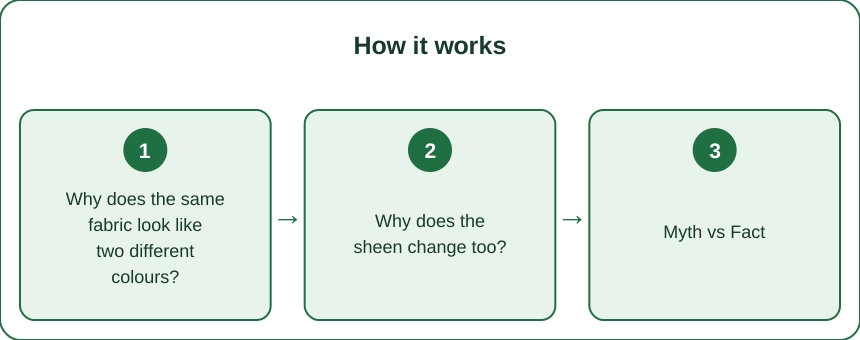
Why does the same fabric look like two different colours?
Because what you see is the light the fabric reflects, and different light sources contain different wavelengths to reflect.
A colour is a fabric’s reflectance profile - which wavelengths it absorbs and which it returns. Change what is arriving and you change what comes back.
Colour temperature is the main variable. Shop lighting is usually in the 4000-5000K range - bright and neutral-to-cool. Domestic lighting is typically 2700-3000K, which is much warmer and contains far more red and yellow and much less blue.
So a black legging with a slightly blue undertone looks deep and cool under shop lights - the light has plenty of blue for it to reflect - and turns warm and brownish at home, where there is barely any blue in the light to return.
This is why blacks and navies are the worst affected. They rely on small amounts of reflected colour to read as deep, and warm domestic light strips exactly the part of the spectrum they need.
Colour rendering matters as much as temperature. Some light sources produce an uneven spectrum with gaps - cheaper LEDs in particular. A fabric whose colour depends on the missing part of the spectrum looks flat and off under them. This is measured as the colour rendering index, and it is why two lamps at the same stated temperature can make the same garment look different.
And there is one more: metamerism. Two fabrics that match perfectly under one light source can visibly mismatch under another, because their reflectance profiles differ even though the result happens to coincide. This is why a matching set stops matching at home, and it is a real manufacturing phenomenon rather than an error.
Why does the sheen change too?
Because sheen is about the direction of the light, not its colour - and shop lighting is far more directional than home lighting.
A fabric’s surface reflects light in two ways. Diffuse reflection scatters in all directions and gives you the colour. Specular reflection bounces at a defined angle and gives you shine.
Bright, directional overhead lighting - which is what shops use - produces strong specular highlights. That is what makes a legging look smooth and lustrous under a spotlight.
Home lighting is generally diffuse - lamps, shades, bounced off walls and ceilings - so specular reflection is scattered and the shine largely disappears. What you see instead is diffuse reflection, which shows the actual surface texture of the knit.
This has a real consequence for flare leggings specifically. The flare means the fabric is hanging away from the leg rather than stretched over it, so there is more free-hanging surface catching the light. The sheen difference shows up more on flares than on a fitted legging, because there is more fabric moving at more angles.
It also affects how the flare itself reads. Directional shop lighting throws a shadow along the inside of the flare, which emphasises the shape and makes the leg line look longer. Flat, diffuse home lighting removes that shadow, and the flare can look less defined than it did.
And a practical consequence: sheerness. Backlighting - a shop’s bright overhead lights, or a window behind you - reveals sheerness that front lighting does not. The single most useful check you can do is turn away from the light source and look over your shoulder in a mirror, or better, have the light behind you.
Myth vs Fact: Clothes and Lighting
Myth: Shop lighting is designed to deceive you. Fact: It is designed to make merchandise look appealing, which is not the same as deception. Bright, cool, directional light genuinely makes fabric look better - deeper blacks, more sheen, less visible texture. Understanding what it does is more useful than being annoyed about it.
Myth: The colour under daylight is the true colour. Fact: There is no single true colour - only the fabric’s reflectance profile. Daylight is the most useful reference because it is broad-spectrum, it is what most people will see you in outdoors, and it is a consistent standard to compare against. That makes it the best reference, not the truth.
Myth: If a set does not match at home, one piece is a different dye lot. Fact: Often it is metamerism instead - two pieces with different reflectance profiles that happen to coincide under one light and diverge under another. Dye lot variation is real too, but a set that matches perfectly in the shop and mismatches at home is more likely the former.
Myth: Fitting room mirrors are slimming on purpose. Fact: The lighting does much more than the mirror. Downward-angled light creates shadows that define shape, and bright even light minimises texture. Both are flattering and neither requires anything unusual about the mirror.
Myth: Black is black. Fact: Black fabrics are dyed with different formulations and have different undertones - blue-black, brown-black, true black. Under warm light the undertone dominates, which is why two black items that look identical in the shop can clearly clash at home.
Myth: Photographing them in the shop tells you the real colour. Fact: Phone cameras apply automatic white balance, which actively corrects for the lighting - so a photo under shop lights is a processed interpretation, not a record. Photos are useful for shape and fit, and unreliable for colour.
How should you actually judge a pair?
Daylight, backlit, and moving - in that order.
Get to a window. Most shops have one, and the fitting room usually does not. Two minutes near daylight tells you more about the real colour than any amount of fitting room deliberation. This is the single most useful habit, and it is free.
Check sheerness with light behind you. Bend, squat, and look over your shoulder in a mirror with the light source behind rather than in front. Front lighting hides sheerness almost completely, which is why people discover it later.
Look at the fabric while it moves. Flare leggings are worn in motion and the hem swings. Sheen, drape and how the flare falls all read differently moving than standing still. Walk a few steps.
Compare against something you already own, in the same light. If you are trying to match a top you have, bring it. Comparing from memory across two different lighting environments is essentially impossible, and this is where metamerism catches people.
Consider where you will actually wear them. If they are for an office with fluorescent overheads, or for evenings out under warm light, that is the condition that matters more than daylight. A pair that looks perfect in daylight and muddy under your office lighting is the wrong pair for the office.
And do a quick check at home before removing tags. Look at them under your own lighting, near your own mirror, with the tops you own. Most returns from a colour mismatch would have been caught by five minutes of this.
One seasonal note: as evenings draw in through autumn, a much larger share of the time you spend in your clothes is under artificial light. A colour judged in August daylight is being worn in October lamplight, and that shift alone changes how a wardrobe reads.
FAQ: Fabric and Lighting Questions, Answered
Why do my leggings look grey at home and black in the shop?
Warm domestic lighting contains very little blue, and most blacks rely on reflecting a small amount of cool light to read as deep. Remove that and the fabric’s underlying undertone - often brown or grey - is what you see. Both appearances are genuine; the shop version simply has more of the spectrum available for the fabric to work with.
Can I trust a photo I take in the fitting room?
For fit and shape, yes. For colour, no. Phone cameras apply automatic white balance that corrects for the lighting, which means the photo is showing you a processed interpretation rather than a record of what you saw. If you want to compare colours, hold the two items together in the same light and look at them directly.
Does the same problem happen with all colours?
It is worst with blacks, navies, deep greens and anything with a subtle undertone, because those depend on small amounts of reflected colour that warm lighting removes. Bright saturated colours shift less noticeably, and mid-tone neutrals like grey and beige sit in between - they mostly shift warm or cool rather than changing character.
TL;DR:
- Colour is a relationship between fabric and light, not a fixed property. Shop lighting is bright, cool and directional; home lighting is warm, dim and diffuse.
- Blacks and navies suffer most - they need cool light to read deep, and warm domestic light strips it.
- Sheen is directional. Shop spotlights create shine that diffuse home lighting removes, and flares show this more because more fabric hangs free.
- Metamerism is why a matching set stops matching at home - two different reflectance profiles that coincide under one light.
- Judge near a window, check sheerness backlit, and look at the fabric moving - and bring the top you want to match.
As the evenings draw in, more of your wardrobe is being seen under lamplight than daylight. Judge accordingly.
See It in Motion
Seen here: High Waist Yoga Leggings with Inner Pocket — shop it on bubblelime.com
Keep Reading
This article is for general informational and styling purposes only. Fit, sizing, and product availability may vary.