Flare Leggings and Closed Shoes: Getting the Break Right
Quick Answer: Closed shoes add 2 to 4cm of height at the heel compared with flat sandals, which shortens the apparent length of a flare and changes where the hem breaks. The rule that works: the hem should sit about 1 to 2cm above the floor with the shoes you are actually wearing, covering most of the shoe but not touching the ground. That means most people need a slightly longer flare for autumn than the one that worked in summer.
The most common autumn version of this going wrong is a flare that now floats above a chunky trainer, which shortens the leg visibly.

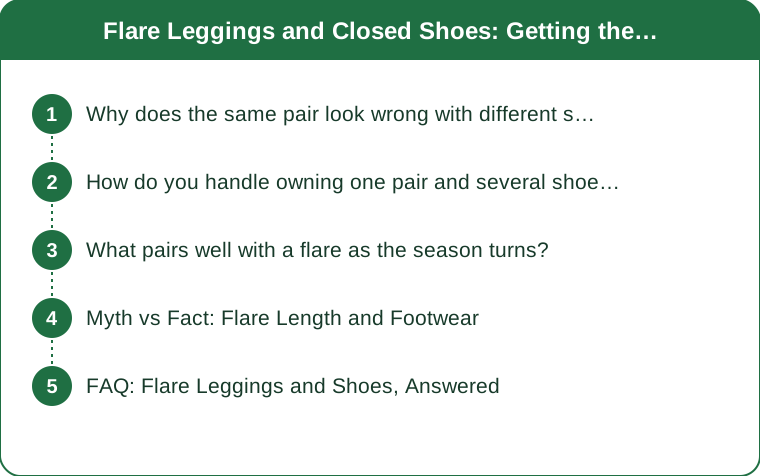
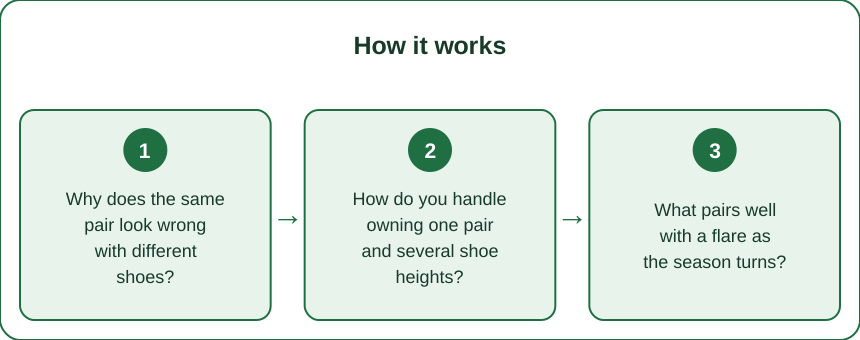
Why does the same pair look wrong with different shoes?
Because the shoe changes both the height of your ankle and the width the hem has to cover.
The height change. Different shoes have very different heel heights:
- Flat sandals: essentially zero to 1cm
- Trainers: typically 2 to 3.5cm at the heel
- Chunky trainers: 3 to 5cm
- Ankle boots: 3 to 7cm
Which means a flare hemmed for sandals sits 2 to 4cm higher in trainers, and that is enough to move it from covering the shoe to floating above it.
The width change, which matters just as much. A flare hem is designed to fall over something. A narrow bare ankle and a wide chunky trainer present completely different shapes, and a flare that drapes cleanly over one can sit awkwardly on the other.
The visual consequence. A flare that ends above the shoe creates a horizontal break at the ankle, which visually shortens the leg. A flare that covers most of the shoe continues the line down to the floor, which lengthens it. This is the whole reason the length question matters.
The target, stated simply. 1 to 2cm of clearance from the floor at the back, with the shoes you are wearing. Enough that the hem does not drag, close enough that the line continues unbroken.
Why this is harder than with straight leggings. A straight legging can end anywhere and read as intentional. A flare has one correct length, because the whole point of the silhouette is the line from knee to floor.
How do you handle owning one pair and several shoe heights?
Three approaches, and one of them solves it permanently.
Approach 1: Hem for your most-worn shoe.
- Pick the shoe you wear most and hem to that. For most people in autumn that is a trainer or an ankle boot
- It will be slightly long with anything flatter and slightly short with anything higher, and both are tolerable within about 2cm
- This is the right answer for a single pair
Approach 2: Own two lengths.
- A shorter flare for flat shoes and a longer one for anything with a heel
- A 3 to 4cm difference covers most of the range
- Practical if flares are a staple rather than an occasional choice
Approach 3: Adjust at the waist, which is the one most people do not think of.
- A high-waisted flare can be worn slightly lower or slightly higher, which changes the hem position by 2 to 3cm
- Rolling the waistband once achieves the same and is instant
- Not a full solution but genuinely useful for a one-shoe-height difference
On hemming a flare, which is not the same as hemming a straight leg:
- The flare shape means the hem circumference changes with length. Taking 5cm off a flare narrows the opening noticeably
- Take less than you think, and check standing in the shoes
- Use a stretch stitch or have it done professionally. A straight stitch on a stretch fabric will pop
- Some flares have a shaped or weighted hem which is difficult to reproduce - worth checking before cutting
The measurement method that works. Stand in the shoes on a hard floor, have someone mark 1cm above the floor at the back, and add 1cm for the hem allowance. Measure at the back, not the front - the back is where dragging happens.

What pairs well with a flare as the season turns?
The silhouette does most of the work, so the rest should be simple.
Shoes, ranked by how well they work:
- Ankle boots with a slight heel. The strongest pairing for autumn. The added height suits the length, and the hem covers the boot shaft cleanly
- Clean low-profile trainers, which work well and keep it casual
- Chunky trainers, which work but need a longer hem - the width of the shoe requires more fabric over it
- Loafers and flats, which need the shortest hem and can leave the leg looking cut off if you get it wrong
- Knee boots, which generally do not work under a flare - the hem sits on the boot shaft and creates bulk
Tops, and the proportion principle:
- A flare adds volume at the bottom, so the top should be fitted or cropped. This is the core rule and it is close to universal
- A fitted long sleeve or bodysuit is the cleanest pairing
- A cropped knit works and adds seasonal texture
- An oversized top over a flare creates volume at both ends, which is a deliberate look but a harder one
- If wearing something loose on top, tuck it or front-tuck it to restore the waist definition the silhouette depends on
Layers:
- A cropped jacket ending at or above the waist, which keeps the vertical line intact
- A long line coat, which works because it runs parallel to the flare rather than cutting it
- A mid-length jacket ending at the hip is the difficult length, because it cuts the leg exactly where the flare begins to widen
Fabric as the season changes:
- Heavier fabrics hold the flare shape better and drape more cleanly over a shoe
- Very light fabrics cling and lose the silhouette, which is why summer flares often look different in autumn
- A slight weight increase is what makes a flare read as seasonal rather than as a summer piece worn late
Myth vs Fact: Flare Length and Footwear
Myth: Flares should just skim the floor. Fact: Touching the floor means the hem wears through and picks up dirt within weeks. 1 to 2cm of clearance at the back keeps the line and protects the garment.
Myth: One length works with everything. Fact: Shoe heel heights range from near zero to 7cm, which is far more than the roughly 2cm tolerance a flare has. Hem to your most-worn shoe and accept a compromise elsewhere.
Myth: A shorter flare is safer. Fact: A flare ending above the shoe creates a horizontal break at the ankle, which visually shortens the leg. Slightly too long looks better than slightly too short on this silhouette.
Myth: Chunky trainers do not work with flares. Fact: They work well, but they need a longer hem than a low-profile shoe because the fabric has to fall over more width.
Myth: You can hem a flare like any other trouser. Fact: Shortening a flare narrows the hem opening, which changes the silhouette. Take less than you think and use a stretch stitch, or the seam will pop on the first wear.
Myth: Flares only work with heels. Fact: They work with flats, trainers and boots. What they need is the correct length for that specific shoe, which is a different requirement from needing height.
FAQ: Flare Leggings and Shoes, Answered
How long should flare leggings be?
About 1 to 2cm above the floor at the back, measured while wearing the shoes you will actually pair them with. Enough to avoid dragging, close enough to keep the line unbroken.
Why do mine look wrong now that I have switched to trainers?
Trainers add 2 to 3.5cm of heel height compared with flat sandals, so a hem that sat correctly in summer now floats above the shoe and cuts the leg at the ankle.
What shoe works best with flares in autumn?
Ankle boots with a slight heel. The added height suits the length and the hem falls cleanly over the shaft without bulk.
Can I hem them myself?
Yes, with a stretch stitch or a twin needle. Take less than you think - shortening a flare also narrows the hem opening and changes the silhouette.
What should I wear on top?
Something fitted or cropped. The flare adds volume at the bottom, so volume at both ends is a much harder look to carry.
Do flares work with chunky trainers?
Yes, but they need a longer hem than low-profile shoes, because the fabric has to drape over considerably more width.
TL;DR:
- Closed shoes add 2 to 4cm of heel height, which is more than a flare’s roughly 2cm tolerance
- Aim for 1 to 2cm of floor clearance at the back, measured in the shoes you actually wear
- A flare ending above the shoe cuts the leg at the ankle; slightly long beats slightly short
- Hem to your most-worn shoe, and use the waistband height to fine-tune by 2 to 3cm
- Fitted or cropped on top - volume at both ends is a much harder proposition
The length did not change. The shoes did, and a flare is the one silhouette where that is immediately visible.
See It in Motion
Seen here: Bootcut Capri Yoga Pants with Pockets — shop similar styles on bubblelime.com
Keep Reading
This article is for general informational and styling purposes only. Fit, sizing, and product availability may vary.