How to Tell When Flare Leggings Are Actually Done
Quick Answer: Flare leggings fail at the hem first because the wide leg drags on the ground with every step. Look for fraying at the back hem edge, a hem that has stretched wider than the front, thinning fabric at the heel line, and finally translucency higher up the leg. The first two are fixable with a simple hem shortening; the last two mean the pair is finished. Most pairs are retired for the wrong signal - a slightly worn hem is not the same as worn-out fabric.
A flare hem takes more abrasion than any other part of any legging you own, which is why it is the most useful thing to inspect.

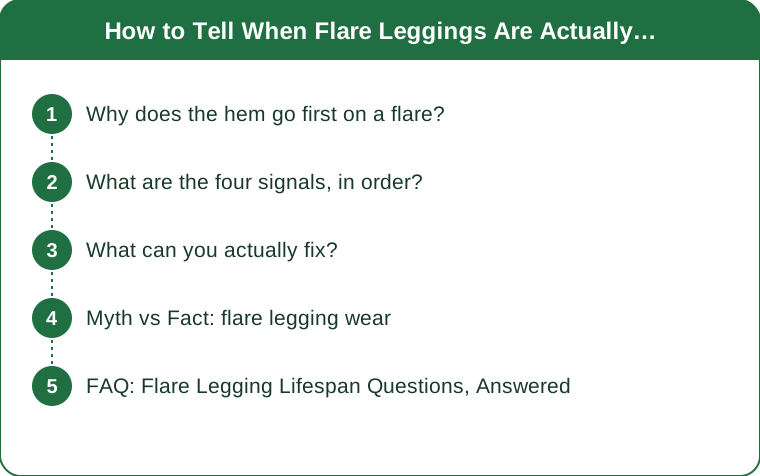
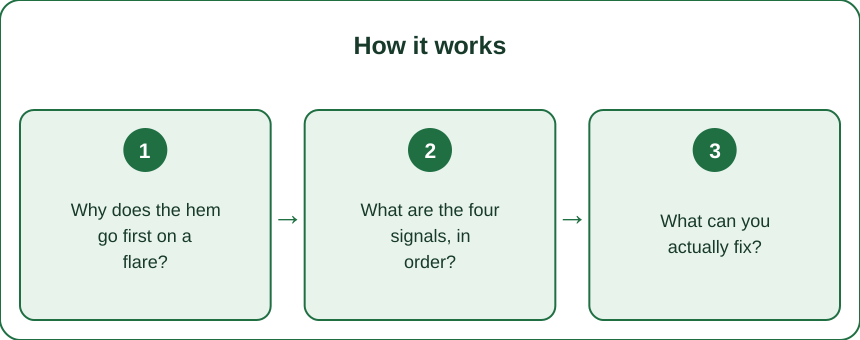
Why does the hem go first on a flare?
Geometry. A flare leg is wider at the bottom than the foot passing through it, so the back of the hem sits closer to the ground and catches with each stride. On a straight legging, the hem sits against the ankle and moves with it.
The back hem specifically. As your foot swings forward, the back edge of the flare trails and touches down. That single point takes contact with pavement, carpet and stairs thousands of times.
Length is the variable. A flare hemmed to just brush the top of the foot barely contacts the ground. A flare that was slightly long, or that stretched over time, contacts constantly.
Shoe height changes everything. The pair that was perfect with a sneaker drags with a flat, and the pair that works with a flat pools with a sandal. Many pairs are worn out simply by being worn with the wrong shoe height for a year.
Which means the fix is often mechanical rather than a replacement: shorten the hem or change the shoe, and the fabric on the rest of the legging still has years in it.
What are the four signals, in order?
1. Fraying at the back hem edge. Small fibers pulling loose along the bottom edge, worse at the back than the front. This is the earliest signal and it is entirely fixable.
2. An asymmetric hem. The back edge has stretched and hangs lower or wider than the front. Lay the leg flat and compare - if the back edge extends noticeably beyond the front, the hem has deformed under repeated drag.
3. Thinning at the heel line. Hold the fabric where your heel sits up to a light. If light passes through there and not elsewhere, the abrasion has gone from the edge into the body of the fabric.
4. Translucency higher up. At the seat, knee or upper thigh. This is fabric fatigue rather than hem drag, and it means the pair is finished as an outer layer.
Signals 1 and 2 are repairs. Signals 3 and 4 are retirements. Most people conflate them, either replacing a pair that only needed shortening or continuing to wear a pair that has gone see-through at the seat.

What can you actually fix?
Shortening the hem is the single highest-value repair on a flare. Cutting off half an inch to an inch of the worn edge and re-hemming removes the damaged fabric entirely and resets the length. On a flare, this changes the width at the hem only slightly.
Use a stretch stitch. A narrow zigzag or a twin needle. A straight stitch on a hem that has to stretch over a heel will pop the first time you pull them on.
Or skip the sewing entirely. Many flare hems are wide enough that a clean cut with sharp fabric scissors leaves an edge that will not run, since knit fabric with a high synthetic content resists unraveling. Test on the inside first and accept that it is a raw edge.
A tailor will do it for a small fee, and it is worth it on a pair you like - typically far less than a replacement.
What you cannot fix: thinning through the body of the fabric or translucency at the seat. No repair adds fabric back, and the pair has reached its useful end as an outer layer even if it is fine for at-home wear.
Myth vs Fact: flare legging wear
Myth: A frayed hem means the leggings are worn out. Fact: it means the hem is worn out, and the hem is a half inch of a garment that is mostly still fine. Shortening it resets the pair.
Myth: Higher price means slower hem wear. Fact: hem wear is driven overwhelmingly by length relative to your shoe height, not by fabric quality. An expensive pair worn slightly too long wears faster than a cheap pair hemmed correctly.
Myth: Washing causes most of the damage. Fact: for the hem specifically, ground contact is the dominant factor by a wide margin. Washing matters much more for pilling and for elastic life than for hem abrasion.
Myth: You should size up for a longer flare. Fact: sizing up gives you more length and more width, which means more drag and faster hem wear. Buy your size and hem to your shoe.
Myth: Once they sag at the knee they are done. Fact: knee sag is often heat-relaxed fiber that partially recovers with a cool wash and a flat dry. Test that before retiring a pair - it recovers more often than people expect.
FAQ: Flare Legging Lifespan Questions, Answered
How long should a pair of flare leggings last?
With regular wear and correct hem length, one to three years of frequent use is typical before the fabric itself fatigues. Hem damage can appear within months if the length is wrong for your shoes, which is a length problem rather than a lifespan problem.
Can I own one pair for both flats and sneakers?
Not ideally. The height difference is usually an inch or more, which is the difference between a hem that brushes and a hem that drags. Many people keep one pair hemmed for each, which is more practical than it sounds.
Is a raw cut edge really okay on a knit?
On most high-synthetic knits, yes - it will not unravel, though it may curl slightly. Test on an inside seam allowance first. If the fabric is a looser knit or has a high natural fiber content, have it hemmed properly.
What about the pair I have already worn through at the seat?
That is genuine fabric fatigue and there is no repair. They are still fine for home wear or under a longer layer, and they are done as a standalone piece.
TL;DR:
- Flare hems wear first because the wide back edge drags with every stride - it is geometry, not quality.
- Four signals in order: back hem fraying, an asymmetric stretched hem, thinning at the heel line, translucency higher up.
- The first two are a hem-shortening repair; the last two mean the pair is finished.
- Hem length relative to your shoe height drives hem wear more than fabric price does.
- Knee sag often recovers with a cool wash and a flat dry - test before retiring.
Most flares get replaced a year early for a half inch of damaged edge. Shorten the hem, match it to the shoe you actually wear, and the rest of the legging keeps doing its job.
See It in Motion
Seen here: High Waist Bootcut Yoga Pants with Side Pockets — shop it on bubblelime.com
Keep Reading
This article is for general informational and styling purposes only. Fit, sizing, and product availability may vary.