Why Flare Leggings Wrinkle Behind the Knee and Nowhere Else
Quick Answer: Behind-the-knee wrinkling happens because the knee is the one joint where a legging must fold rather than stretch, and a flare cut has more fabric there than a straight legging does. Sitting for 60 minutes or more sets the fold, and lower-recovery fabrics keep it. It is a recovery problem, not a size problem — going up or down a size makes it worse, not better.
You stand up after a long meeting and there is a stack of horizontal creases behind each knee that were not there this morning.
Everyone assumes this means the leggings are too big. It almost never does.
Why the knee specifically?
Because it is the only place on a legging where the fabric has to concertina rather than stretch.
When you bend your knee to 90 degrees, the fabric on the front of the leg stretches lengthways and the fabric on the back is compressed — it has more length than the shortened path requires. Fabric under compression does not shrink. It folds.
The number of folds depends on how much surplus there is, which is why a flare or bootcut leg wrinkles more visibly than a tight-to-the-ankle legging. A flare has a wider leg below the knee, which means more fabric circumference in the area, which means the surplus has more room to gather into distinct creases rather than being held smooth by tension.
Hip and knee angle stack. Sitting flexes the hip and the knee simultaneously, so the fabric behind the knee is being compressed from both directions. This is why the creasing is far worse after sitting than after squatting.
Time under fold is what sets it. A fold held for two minutes disappears immediately. A fold held for an hour has had time to warm to body temperature under pressure, which is a mild version of the heat-setting process used to finish fabrics. That is the whole mechanism.
Which is why the seat matters. A firm office chair produces sharper creasing than a soft sofa, because the pressure is more concentrated. A car seat with a defined edge under the thigh is the worst common case.
Why sizing up or down makes it worse
Because both directions increase the surplus problem in different ways, and this is the mistake people make first.
Sizing up adds fabric circumference everywhere including behind the knee. More surplus, more folds, deeper creases. It also reduces the tension holding the fabric against your leg, and tension is what smooths creases out as you walk.
Sizing down increases tension, which sounds like it should help. In practice it forces more extreme stretch on the front of the knee during bending, and the fabric recovers from that stretch by pulling the back into tighter folds. Very tight leggings crease differently — fewer, sharper lines rather than a stack — and those are harder to release.
The variable that actually predicts it is fabric recovery. A high-recovery fabric returns to shape within a minute or two of standing, taking the creases with it. A low-recovery fabric holds the fold.
The ten-second test tells you before you buy: stretch a section of fabric fully, hold for a full ten seconds, and release. Good fabric snaps back with no visible distortion. If you can still see a slack area after five seconds, that pair will hold knee creases all day.
Elastane content is a rough proxy — under 8 percent tends to crease and hold; 15 to 20 percent with a quality covered elastane recovers well. But recovery quality varies at the same percentage, which is why the physical test beats the label.
Fabric weight matters too. Very light fabrics fold into many fine creases; mid-weight fabrics with some structure fold into fewer and release faster. This is one of the cases where a slightly heavier legging performs better.

5 Mistakes That Make Knee Creasing Worse
1. Ironing them. The single fastest way to make a temporary crease permanent. Direct iron heat on synthetic fabric sets the fold exactly as the factory would. If your leggings have a crease you cannot remove, this is usually how it happened.
2. Tumble drying. Heat plus tumbling in a crumpled state sets folds throughout the garment. It also degrades elastane, which reduces recovery, which increases creasing permanently. This is the compounding one — every hot cycle makes the next crease harder to release.
3. Folding them at the knee for storage. A drawer fold that happens to land mid-leg, under the weight of a stack, is low pressure for a very long time. Rolling from the waistband or hanging by the waist avoids it entirely.
4. Wearing the same pair on every long-sitting day. Elastane needs a full rest between wears to recover its shape. A pair worn on consecutive desk days never returns to baseline and progressively creases more. Alternating two pairs genuinely changes this.
5. Buying based on how soft the fabric feels in the shop. Buttery-soft fabrics are usually lofted and lower in recovery. The pair that feels marginally less luxurious frequently creases far less, and softness in a shop is often a washable finish anyway.
How do you actually get the creases out?
Warmth and gentle stretch, applied without contact. It takes about two minutes.
The fastest fix, while wearing them: stand up, and do five to ten slow, full knee bends, letting the leg straighten completely each time. Movement plus body heat plus the fabric’s own recovery removes most fresh creasing within a couple of minutes. If you have been sitting for hours, walking for five minutes does the same thing passively.
For set creases, use steam. Hang the leggings and hold a garment steamer five to eight centimetres away — never touching — passing slowly over the crease. Then gently stretch the fabric lengthways while it is warm and let it cool hanging. Expect most of the crease to release.
The bathroom method works without a steamer: hang them in the room during a hot shower for ten minutes, then stretch and hang to cool.
Never iron, never press. Contact heat is what sets creases permanently.
Prevention, in order of effect:
Stand up every 45 to 60 minutes. This is good advice for other reasons and it happens to be exactly the timescale at which knee folds start to set.
Alternate pairs on consecutive desk days.
Air dry, always, and hang from the waistband rather than folding over a rail at the knee.
Choose higher-recovery fabric next time, tested with the ten-second method.
Seasonal note: creasing gets noticeably worse from about now onward, for two reasons. Cooler weather means more sitting indoors, and flare leggings start being worn under longer tops and boots where fabric-on-fabric contact adds friction at exactly the knee area. If your leggings creased fine all summer and are suddenly a problem, nothing about them changed.
FAQ: Knee Crease Questions, Answered
Is creasing a sign of poor quality?
Some creasing is universal and unavoidable — it is geometry. Creasing that does not release after five minutes of walking indicates low fabric recovery, which is a quality signal.
Do flares crease more than skinny leggings?
Yes, visibly, because there is more fabric circumference below the knee to gather into folds. The trade-off is that flares are more comfortable to sit in, which is often why people chose them.
Will the creases become permanent?
Only with heat. Creases set by sitting release with steam and movement. Creases set by an iron or a tumble dryer generally do not.
Does the fabric type matter more than the price?
Yes. Recovery quality is the variable, and it does not track price reliably above the mid range. The ten-second stretch test in a fitting room beats the price tag every time.
Why does one pair crease and another does not, at the same size?
Different fabric platforms. Brands run several fabrics across a range, and the same size in two products can behave completely differently. This is also why a repurchase of a favourite pair sometimes disappoints.
Anything I can do at a desk right now?
Stand and do ten slow knee bends. It looks like a stretch break, which it also is, and it removes most of the day’s creasing in under a minute.
TL;DR:
- The knee is the one place fabric must fold rather than stretch — flares have more surplus there, so more folds.
- Sitting for an hour or more sets the fold with body heat. Two minutes does nothing.
- It is a recovery problem, not a sizing problem. Sizing up or down both make it worse.
- Never iron, never tumble dry. Steam held away from the fabric, then stretch while warm.
- Stand and bend the knees ten times, or alternate two pairs across consecutive desk days.
Use the ten-second stretch test before buying and this mostly stops being a problem you have to manage.
See It in Motion
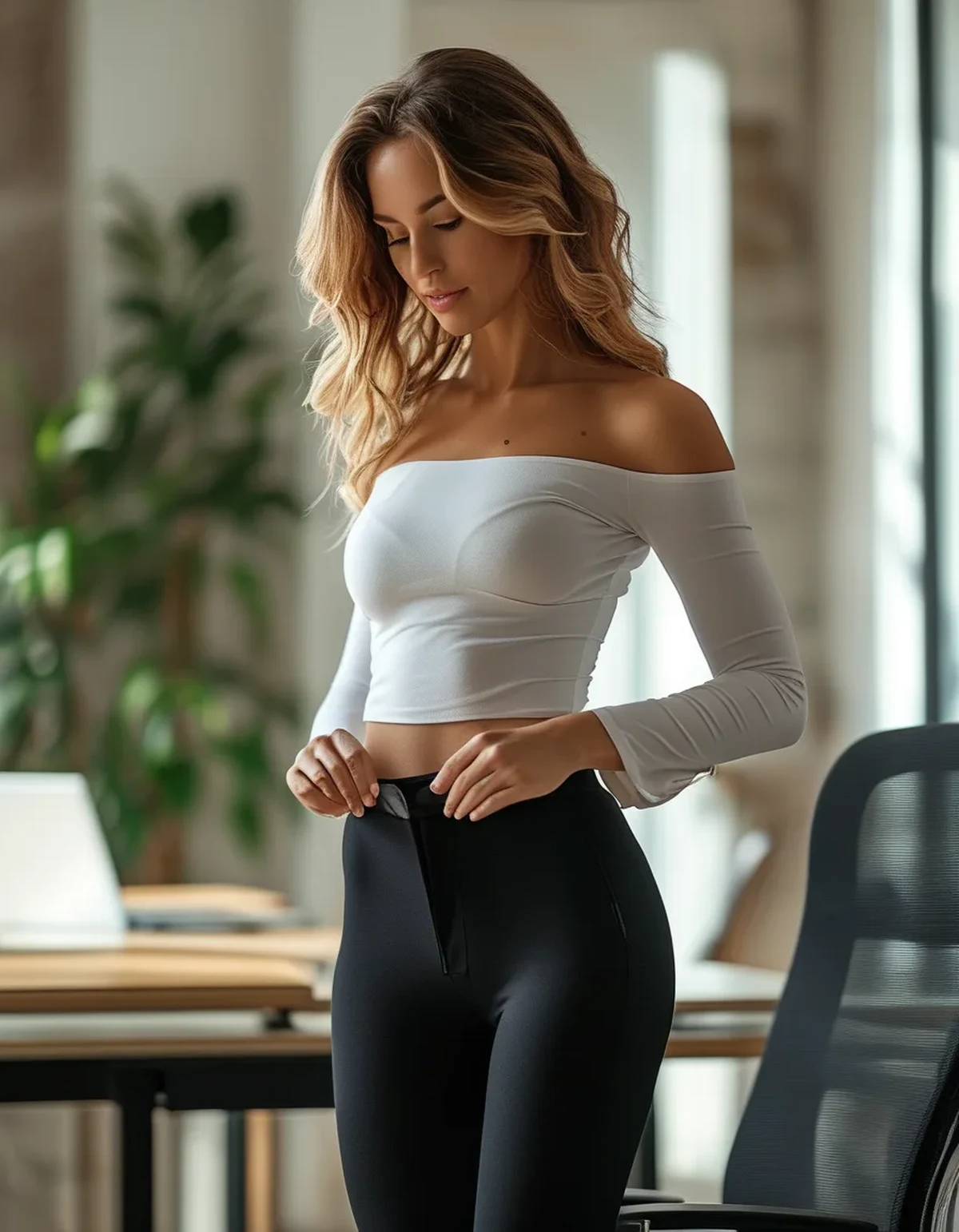
Seen here: High Waist Bootcut Yoga Pants — shop it on bubblelime.com
Keep Reading
This article is for general informational and styling purposes only. Fit, sizing, and product availability may vary.