Flare Leggings and Static: Why It Starts in Early Autumn
Quick Answer: Static builds when humidity drops, which happens the week indoor heating starts. Synthetic fabrics like polyester and nylon hold charge readily, and a flare hem has more free-moving fabric than a fitted one, so the cling is more visible. The fixes that actually work, in order: raise humidity, stop using dryer sheets and switch to a proper anti-static approach, add a layer of natural fibre against the skin, and lightly dampen the hem before leaving. Fabric softener is a partial fix with real costs.
All summer they hung perfectly.
Now the hem wraps around your calf every third step.
Nothing changed about the leggings. The air changed.
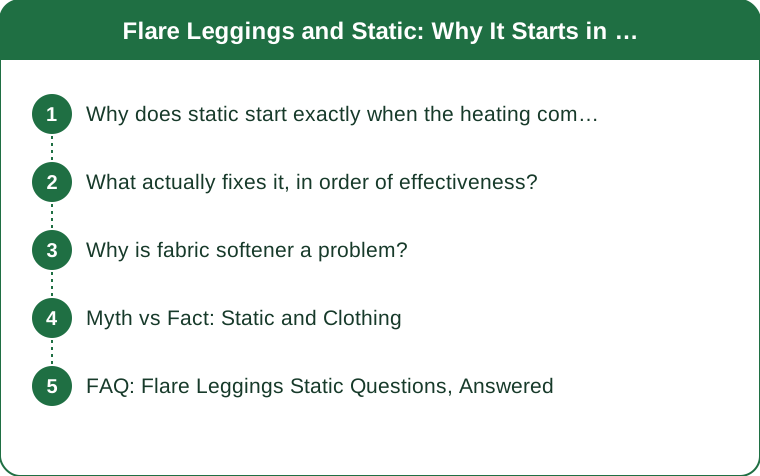
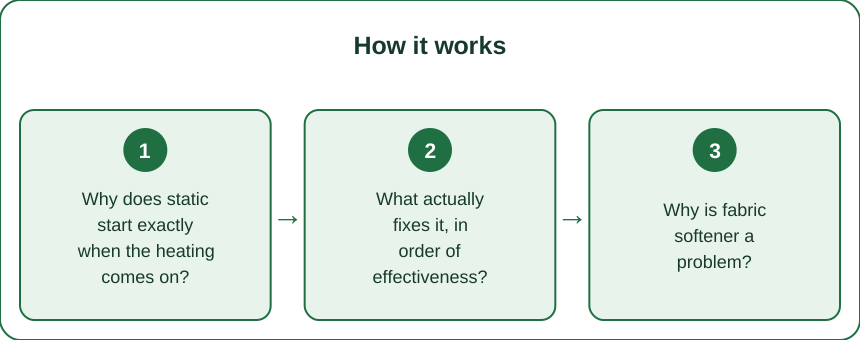
Why does static start exactly when the heating comes on?
Because humidity is what normally drains the charge away, and heated air has much less of it.
Static builds when two materials rub together and electrons transfer between them, leaving one surface positively charged and the other negatively. This happens constantly, all year round.
What changes is whether the charge stays. Moisture in the air provides a conductive path for charge to dissipate. In humid conditions the charge leaks away as fast as it builds; in dry air it accumulates.
Indoor heating drops relative humidity substantially - often into the 20-30% range in cold weather, compared with 50-60% in summer. That is the whole explanation for the seasonal timing.
Why synthetic fabrics are worse: polyester and nylon are poor conductors and hold charge well. Natural fibres like cotton and wool absorb some ambient moisture, which helps the charge dissipate. Most flare leggings are predominantly synthetic.
Why flares specifically show it more: a fitted legging is already against the leg, so cling changes nothing visually. A flare hem is supposed to hang away from the leg - so when it clings, the entire silhouette the garment exists for disappears.
And why it is worse in autumn than midwinter for many people: the transition period involves moving between still-humid outdoor air and newly dry indoor air, and the contrast is at its most noticeable in the first few weeks.
What actually fixes it, in order of effectiveness?
Humidity first, everything else second.
1. Raise indoor humidity. This addresses the cause rather than the symptom and it is the only fix that works on everything at once. A humidifier in the room you get dressed in, targeting 40-50%, largely eliminates the problem. Drying laundry indoors has a similar effect at no cost.
2. Stop over-drying in the tumble dryer. Tumble drying is a static generator - friction between fabrics in dry heat is exactly the charging mechanism. Removing clothes while slightly damp and hanging them to finish removes most of the charge. Better still, hang dry entirely.
3. Wear a natural fibre layer against the skin. Skin-to-synthetic contact is where a lot of the charge generates. A cotton or wool blend layer between reduces it noticeably, which is why static is often worse over bare legs than over a base layer.
4. Dampen the hem lightly before leaving. A light mist of water on the flare portion works immediately and lasts an hour or two. Crude, effective, free.
5. A dedicated anti-static spray. Works well and lasts longer than water. A homemade version is a small amount of fabric conditioner heavily diluted in water in a spray bottle, misted lightly on the inside of the hem.
6. Metal. Running a metal object - a coat hanger, a safety pin held against the fabric - along the inside of the hem discharges it. Sounds like folklore and is straightforward physics. A small safety pin in the inside seam works as a slow continuous version.
What is on the list and should not be at the top: fabric softener.

Why is fabric softener a problem?
It works on static and costs you the things the fabric was bought for.
Fabric softener works by depositing a thin lubricating film on fibres, which reduces friction and therefore reduces charge generation. The static reduction is real.
The cost is that the same film:
- Reduces moisture wicking, which is the main technical function of athletic fabric
- Reduces breathability over repeated use as residue builds
- Traps odour-causing bacteria in the residue, which is why softener-treated activewear often smells worse over time rather than better
- Degrades any water-repellent finish
For a flare legging worn casually rather than for training, the trade-off is more defensible - the wicking matters less if you are not sweating in them. For anything you train in, it is a bad deal.
A better version of the same idea: wool dryer balls reduce static somewhat without leaving a chemical residue, and adding a small amount of white vinegar to the rinse cycle softens fabric slightly without coating it.
And dryer sheets specifically are worth stopping entirely on athletic fabric. They leave the heaviest residue of any of these options, and the static benefit lasts only until the next wash while the residue accumulates.
The honest summary: if static is your only problem and the leggings are not training kit, softener is a reasonable choice. If they are training kit, use humidity and hang drying instead.
Myth vs Fact: Static and Clothing
Myth: Static means the fabric is cheap. Fact: It is about fibre type and ambient humidity, not quality. Expensive polyester holds static exactly as well as cheap polyester, and the difference between summer and winter proves the air is the variable.
Myth: Fabric softener is the standard fix. Fact: It works and it coats fibres, reducing wicking and trapping odour. For anything you train in, hang drying and a humidifier are better answers.
Myth: Static is worse in the cold. Fact: It is worse in dry air. Cold outdoor air holds less moisture and heated indoor air holds even less, which is why the problem tracks the heating season rather than the outdoor temperature directly.
Myth: Rubbing the fabric helps. Fact: Rubbing generates more charge - it is the mechanism causing the problem. Touching something metal or lightly dampening the fabric are the useful versions.
Myth: Natural fibres never build static. Fact: They build less because they absorb ambient moisture, which drains the charge. In very dry conditions even cotton and wool can build noticeable static.
Myth: You have to choose different leggings. Fact: The same pair behaves completely differently at 50% humidity. Fixing the environment fixes every synthetic garment you own at once, which is why it is first on the list.
FAQ: Flare Leggings Static Questions, Answered
Why only my flare pair and not my fitted leggings?
Fitted leggings are already against the leg, so cling changes nothing visible. A flare hem is designed to hang away, so static removes the exact silhouette you bought them for. Both pairs are charging equally.
Does a humidifier really help?
More than anything else on the list, because it addresses the cause. Targeting 40-50% relative humidity in the room you dress in largely eliminates the problem across every garment at once.
Is fabric softener safe for leggings?
It reduces static and coats fibres, which reduces wicking and traps odour over time. Acceptable for casual-wear flares, not advisable for anything you sweat in. Wool dryer balls are a lower-cost alternative.
What is the quickest fix when I am already dressed?
Lightly mist the inside of the hem with water, or run a metal coat hanger along the inside of the fabric. Both work in seconds and the water version lasts an hour or two.
Will washing them differently help?
Yes - hang drying rather than tumble drying removes the main charging step. Tumble drying in dry heat is the single biggest static generator in a normal laundry routine.
Does a slip or base layer underneath help?
Usually yes, and a natural fibre one helps most. Skin-to-synthetic contact generates a lot of the charge, so a cotton or wool-blend layer in between reduces it noticeably.
TL;DR:
- Static builds year-round; humidity normally drains it, and indoor heating removes the humidity
- Synthetic fabrics hold charge; flare hems make the cling visible in a way fitted pairs do not
- Best fixes in order: raise indoor humidity, stop tumble drying, natural fibre layer underneath, damp the hem
- Fabric softener works and coats fibres, reducing wicking and trapping odour - avoid on training kit
- Wool dryer balls and diluted vinegar in the rinse are better laundry-side options
- Metal against the fabric discharges it in seconds when you are already out the door
The leggings did not change. Fix the air and every synthetic garment you own improves at once.
See It in Motion
Seen here: Bootcut Yoga Pants with Side Pockets — shop it on bubblelime.com
Keep Reading
This article is for general informational and styling purposes only. Fit, sizing, and product availability may vary.